
Pallet forwarding
from Europe to anywhere
Buy from as many suppliers as your order needs, receive everything at our warehouses in ten countries, and ship once: one professionally built pallet with the export documentation done a single time. This page is the neutral starting point — pick your destination below and you land on the page that carries the customs detail for it, or tell us the lane if it is not listed.
Where does the pallet have to land?
Every destination below has its own page with the customs detail that actually applies there. If yours is not listed, the service is the same — tell us the lane and we quote it.
🇺🇸 United States
Formal entry above the de minimis threshold, so the paperwork is what decides how the pallet clears.
🇲🇽 Mexico
The lane both published pallet cases actually ran on, with the TLCUEM preference explained.
🇧🇷 Brazil
The largest economy on the continent, and this site's second-biggest bloc of signups.
🇦🇷 Argentina
No duty table published on purpose: the rules moved too recently for a rate sheet to be safe.
🇨🇴 Colombia
The lane the published elevator shipment ran on out of Spain — two door leaves and a motor, 280 kg.
🇨🇱 Chile
A smaller market than its neighbours but an unusually open one, and a frequent first destination.
🇵🇪 Peru
Formal import through a customs agency above US$2,000 FOB, and the 10% IGV advance on a first import explained.
🇪🇨 Ecuador
15% IVA, FODINFA and the 5% tax on paying your supplier abroad, explained before you place the order.
🇩🇴 Dominican Republic
EU–CARIFORUM preference with an EUR.1 or invoice declaration, 18% ITBIS and the importer set-up explained.
🇵🇦 Panama
7% ITBMS, a licensed customs broker for commercial imports, and the EU–Central America agreement explained.
🇨🇷 Costa Rica
A customs agent is mandatory for commercial imports; the EU–Central America agreement explained.
🇬🇹 Guatemala
SAT importer registry, 12% IVA and the EU–Central America agreement, explained for a company import.
🇺🇾 Uruguay
Mercosur tariff, 22% IVA with a 10% advance, and the EU–Mercosur preference applied since May 2026.
🇻🇪 Venezuela
Limited air capacity from Spain since Maiquetía reopened (Sept 2026); 16% IVA and import permits explained.
🇨🇦 Canada
A high-income market across the Atlantic, with a dated customs sheet for a company import.
🇦🇺 Australia
One of the longest lanes out of Europe, where consolidating suppliers into one pallet pays off most.
🇮🇱 Israel
The market that responds best to this site, with a dated customs sheet for a commercial entry.
🇦🇪 United Arab Emirates
The Gulf's trading hub: commercial goods enter under a registered importer, explained on the page.
🇸🇦 Saudi Arabia
5% GCC duty on most goods, 15% VAT and SABER certificates for regulated products, explained.
🇪🇸 Spain
0% EU duty on in-scope US-origin goods since 1 Jul 2026; 21% import VAT; your broker files the DUA
🇬🇧 United Kingdom
No US trade agreement: UK Global Tariff rates, 20% import VAT, postponed VAT accounting if VAT-registered
🇩🇪 Germany
0% EU duty on in-scope US-origin goods; 19% import VAT (EUSt); origin must be provable
🇮🇪 Ireland
0% EU duty on in-scope US-origin goods; 23% import VAT; postponed accounting for registered traders
🌎 Latin America
For when the destination is not settled yet, or one supplier feeds several countries.
Or start from where you buy
Any other destination — the UK, New Zealand, Japan, anywhere — is quoted the same way. Pick the country in the quoter.
My destination is not listedEstimate a shipment before you talk to us
Price a real weight and volume, then send us the details for a commercial quote.
Quote reply: within 24 business hours from Spain and Italy, up to 3 business days from our other countries.
The European price works at pallet scale. Parcel by parcel, it evaporates.
The supplier quotes ex-works and stops there
The European manufacturer or distributor with the right price has a domestic sales desk, not an export one. It will deliver to an address in its own country without blinking.
Loose parcels destroy the freight economics
A dense commercial order shipped box by box pays courier pricing on every box. Consolidated onto one properly built pallet, the same order is weighed, documented and priced once.
Generic freight pages answer someone else's route
Duty, entry thresholds and paperwork are not universal — they are per country. That is why every lane below has its own page instead of one page pretending to cover all of them.
Documentation is where shipments actually stall
An invoice that does not match the crate, a missing packing list or an absent origin declaration hold a pallet at destination far more often than the flight does.
From our warehouses worldwide to your doorstep — in four moves.
Resendify gives you a real local address at our warehouses. Shop where the deals are, we collect, repack and forward — you stay in control the whole way.
- Sign up
Get your local address
Pick one of our warehouses in 10 countries across Europe, the US and Asia. We assign you a real street address — yours within minutes.
Ready in 2 minutes - Shop
Buy from any store
Use your Resendify address at checkout — Amazon DE, Zara, Decathlon, eBay, anywhere. Even sellers that don't ship abroad.
Works with 10k+ shops - Consolidate
We receive and forward
Photos on arrival, optional repacking, and consolidation of multiple orders into one shipment to save up to 70%.
Up to 70% off shipping - Ship
Worldwide to your door
Pick your courier and track door-to-door. Email alerts on every tracking update.
Live email alerts
Warehouses and receiving points across key global markets
We can receive your packages in multiple strategic countries, giving you access to stores, suppliers and marketplaces that would otherwise be hard to reach internationally.
What our clients palletize
What a pallet with us actually is
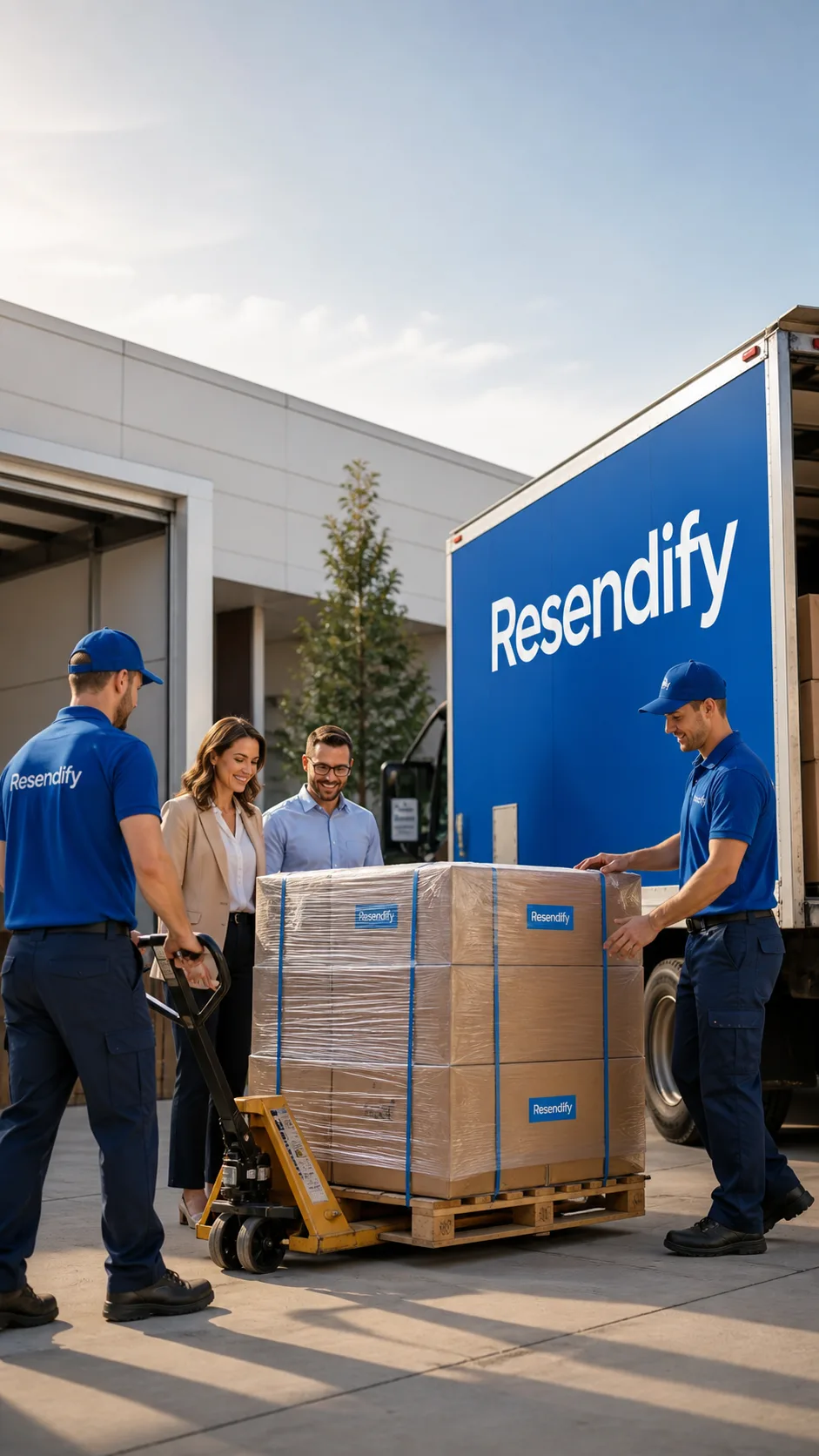
A pallet is not a big parcel. It is a load that has been built: received from however many suppliers the order needs, checked against what you bought, photographed, weighed and measured, then stacked so it survives a flight and a forklift.
The blocker is almost never the supplier's willingness to sell. It is that a European factory or distributor is set up to invoice and deliver inside its own country, and an overseas buyer is not the customer its logistics were built for.
A local address in that country turns your export problem back into the domestic delivery it already knows how to do — and that works the same in all ten countries where we receive: Spain, Italy, France, Germany, the United Kingdom, Türkiye, the Czech Republic, the United States, China and Hong Kong.
From there it is ours, and it is physical. Fragile faces get edge protection and corner boards; heavy items go to the base and the weight is spread so the load travels square; the stack is strapped and wrapped, and wood packaging is ISPM-15 treated. Then the paperwork happens once for the whole pallet instead of once per box: one commercial invoice that matches the contents, one packing list, real weights and dimensions.
- Receiving addresses in ten countries, so each supplier ships domestically.
- Consolidation across as many suppliers — and as many of our warehouses — as the order needs.
- Professional palletizing: edge protection, weight distribution, strapping, ISPM-15 wood.
- One commercial invoice and one packing list for the whole shipment.
- Air consolidation, quoted per shipment on the Business plan.
Which origin should your pallet leave from?
Usually you do not choose the origin — your supplier does, and the answer is simply the country it delivers to. The question only becomes real when the same product exists in two of our countries, or when an order is split across them.
Spain and Italy have dedicated pages because they are where most of our palletized volume comes from and because what they export is different in kind. Spain sends Castellón ceramics and Porcelanosa surfaces, HPL and technical panels, interiors, building materials, gym and hospitality equipment. Italy sends elevator doors and components, vehicle and motorsport parts, Carrara stone, Sassuolo porcelain, espresso machines and professional kitchen lines, design furniture and machinery spares.
The other eight receiving countries work exactly the same way; they just do not have a landing page of their own yet.
And a mixed order is normal — we receive in ten countries, so a pallet can be built from suppliers in several of them. What we will not do is pretend that is free: moving goods between our warehouses to build one pallet is a real cost and gets quoted as a visible line. Sometimes two pallets from two origins beat one consolidated pallet, and we will say so rather than sell you the tidier-sounding option.
- The origin is normally decided by where your supplier delivers, not by you.
- Spain and Italy have their own pages; France, Germany, the UK, Türkiye, Czechia, the US, China and Hong Kong receive the same way.
- One pallet can combine suppliers from several of our countries.
- Inter-warehouse movement is a real cost and appears as a visible line in the quote.
Duties and taxes: who does what
This page deliberately carries no duty table, because a rate only means something once the destination and the tariff code are known. Each country lane linked above carries its own dated sheet where we have a verified one — and where we do not, such as Argentina, the page says so instead of guessing.
What is stable everywhere is the division of work. Import duties and taxes are assessed at destination on the customs value; they are the importer's; we do not collect them upfront and we do not estimate them as a fixed percentage, because the tariff classification is your customs broker's call and their liability.
What we do is make that entry easy to file: one consolidated shipment, a commercial invoice that matches what is actually in the crate, a packing list, real weights and dimensions, and the supplier's origin declaration — the document that decides whether you pay a preferential rate or the full one.
- No duty percentages on this page: without a destination and a tariff code they would be fiction.
- Duties and taxes are assessed at destination and are the importer's.
- Classification is your customs broker's decision, not ours.
- We supply the documents that make the entry filable, including the origin declaration.
What we publish, and what we will not pretend
Three operations are published on this site with their real figures. An HPL pallet: 150 panels, 296 kg, one pallet, the logistics bill in full, 17 days documented door to door — Spain → Mexico. A gym fit-out: 24 packages, 317 kg consolidated into a single pallet — Spain → Mexico. And an elevator shipment: two door leaves at 78 kg each plus a 124 kg traction motor, 280 kg — Spain → Colombia.
That last one came out at about €15 per kilo, and we would rather explain the number than let it set an expectation we cannot repeat: it was a last-minute opportunity on that route. The realistic reference for that lane is nearer €20 per kilo, and that is what a quote today is built against.
Those are the only figures we will quote, and only ever attached to the route they actually ran on. Yours gets priced on your weight, your volume, your route and your pickup — which is also why a pallet quote is not instant. Transit is an orientative band anchored on those cases, never a delivery promise.
What Resendify does for a business, and what it does not
Being precise about the boundary is more useful than a list of promises. We operate receiving warehouses across ten countries — Spain, Italy, France, Germany, the United Kingdom, Türkiye, the Czech Republic, the United States, China and Hong Kong — so your suppliers deliver domestically, which is what most of them are set up to do.
We check goods in, store them while an order builds across several suppliers, repack when the original packaging is not built for an international leg, consolidate into one shipment, and produce the export documentation: commercial invoice, packing list, real weights and dimensions, and the supplier origin documents that decide whether you pay a preferential duty rate or a full one.
What we are not is your customs broker in the destination country, a distributor, or a party to your trade terms. We do not clear goods on your behalf at destination, we do not hold stock we sell you, and we do not negotiate or guarantee terms with brands.
We also do not quote transit times we cannot control, and we do not tell you your goods will clear without charges. The Business plan exists precisely because a recurring importer needs a quote-based setup rather than a consumer membership: tailored workflows for repeat imports, room for packaging and repacking, volume-oriented planning and commercial support on request.
- Receiving warehouses in 10 countries so suppliers deliver domestically
- Check-in, storage while an order builds, and repacking for the international leg
- Consolidation into one shipment with commercial invoice, packing list, weights and dimensions
- We chase supplier origin declarations — the document that decides preferential duty
- We are not your destination customs broker, not a distributor, and not a party to your trade terms
- Business plan is quote-based: tailored workflows for repeat imports, volume-oriented planning
Pallet forwarding: what buyers ask
Start from your supplier, not from a map. Tell us who you buy from and where it has to land, and the origin follows: it is the country your supplier already delivers to. If your order spans suppliers in two of our countries, say so — we will tell you whether one consolidated pallet or two separate ones works out better, and we will show the difference rather than assert it.
It depends on where the goods are collected. From Spain and Italy we reply within 24 business hours. For our other countries we first request the rate at origin, so the quote can take up to 3 business days. Either way a person prices it against your real weight, volume, route and pickup; if you have a deadline, say so and we prioritise it.
One pallet is the format, not a minimum we tolerate. You can start with a single order. Recurring or larger programmes move to the Business plan, which is quote-based precisely because pallet operations differ too much for a fixed membership — see the pricing page for how the plans compare.
Our pallet service is air consolidation, and that is the honest scope. It is the right answer when the order is dense but not enormous, when it is worth more per kilo than a container's economics assume, or when a project cannot wait. It is the wrong answer for a full project quantity of dense stone or tile, and we say so on that page rather than quoting you air freight for it.
Air freight is charged on chargeable weight: the higher of the real weight and the volumetric weight, which in air cargo is usually length × width × height in cm divided by 6,000 (about 167 kg per cubic metre). A light but bulky pallet pays for its volume. Pickup, consolidation, palletizing, export paperwork and the route itself come on top. We don't publish a rate card because it moves with route and date: enter real weights and measures in the quoter and a person prices that exact load.
A parcel-forwarding address — what Latin America calls a casillero — receives personal purchases and forwards them by courier as parcels: built for individuals and occasional orders. Consolidated cargo gathers orders from one or several suppliers into a single commercial shipment, with an invoice, a packing list and a formal import at destination. Resendify does both, but they are different services: if you buy for resale or for a project, consolidated cargo is the one for you.
We are a forwarder and consolidator with warehouses in ten countries: we receive your suppliers' goods, consolidate and palletize them, prepare the commercial invoice and packing list, and quote the air freight to your country. What we don't do is customs clearance at destination: that entry is filed by your local customs broker, who holds the licence there.
Volume and rhythm change what you need. A consumer account is built around occasional parcels; a business buying every month needs storage that fits a build-up across suppliers, packing decisions made per shipment, documentation that a customs agent can file without chasing you, and a quote rather than a fixed membership. That is what the Business plan is for, and it is priced per case because a pallet of tools every month and a monthly box of collectibles are not the same operation.
No. Clearance at destination is done by you or your customs broker, and that is deliberate: local clearance requires local licensing and local liability. What we do is the European side and the paperwork that makes clearance straightforward — a consolidated shipment, a commercial invoice that matches the goods, a packing list, real weights and dimensions and the supplier's origin documents.
Talk to us about the specific supplier before you plan around it. Some situations are simply a delivery address problem, which your European address solves outright. Others involve trade accounts or territorial agreements that are between you and the brand, and no forwarder can resolve those — we would rather tell you which one you are facing than take the order and find out later.
Other ways we move heavy cargo
Many suppliers in, one documented shipment out — one freight and one customs entry.
The sector behind one of our published cases: 280 kg of door leaves and a traction motor.
Bearings, gearboxes, drives and hydraulics — including the spare that has a line stopped.
150 panels, 296 kg on one pallet, with the real logistics bill published in full.
Pallet operations run on the quote-based Business plan. The comparison table is on the pricing page.
Enquiries answered within 24 business hours; a pallet price takes up to 3 days because a person builds it.
Tell us what you import
The more concrete this is, the more useful our reply. We receive in ten countries — Spain, Italy, France, Germany, the UK, Türkiye, the Czech Republic, the United States, China and Hong Kong — and forward anywhere, so tell us where you actually buy and where it actually has to land, even if this page is about a different lane.
Start importing palletized cargo from Europe on a schedule that fits your business
Tell us what you buy and how often, and we will come back with a setup and a quote — not a generic membership.