
Pallet shipping from Italy
to Colombia
Several suppliers from Italy consolidated into one professionally built pallet, export documentation done once, and air freight for an order that cannot wait for a container. Colombia is the lane the elevator shipment published on this site actually ran on — two door leaves and a motor, 280 kg out of Spain. Quoted per shipment on the Business plan.
Estimate a shipment before you talk to us
Price a real weight and volume, then send us the details for a commercial quote.
From Italy, we reply with your quote within 24 business hours.
The European price works at pallet scale. Parcel by parcel, it evaporates.
The courier regime is not built for your stock
The de minimis conversation belongs to the courier modality, which exists for occasional non-commercial shipments. A company buying inventory files an ordinary import against its NIT. Costing a purchase order on courier thresholds is how importers end up with a landed cost they did not plan for.
The supplier quotes ex-works and stops there
The Italian manufacturer or distributor with the right price has a domestic sales desk, not an export one. It will deliver to an address in its own country without blinking.
Loose parcels destroy the freight economics
A dense commercial order shipped box by box pays courier pricing on every box. Consolidated onto one properly built pallet, the same order is weighed, documented and priced once.
From our warehouses worldwide to your doorstep — in four moves.
Resendify gives you a real local address at our warehouses. Shop where the deals are, we collect, repack and forward — you stay in control the whole way.
- Sign up
Get your local address
Pick one of our warehouses in 10 countries across Europe, the US and Asia. We assign you a real street address — yours within minutes.
Ready in 2 minutes - Shop
Buy from any store
Use your Resendify address at checkout — Amazon DE, Zara, Decathlon, eBay, anywhere. Even sellers that don't ship abroad.
Works with 10k+ shops - Consolidate
We receive and forward
Photos on arrival, optional repacking, and consolidation of multiple orders into one shipment to save up to 70%.
Up to 70% off shipping - Ship
Worldwide to your door
Pick your courier and track door-to-door. Email alerts on every tracking update.
Live email alerts
Warehouses and receiving points across key global markets
We can receive your packages in multiple strategic countries, giving you access to stores, suppliers and marketplaces that would otherwise be hard to reach internationally.
What our clients palletize from Italy
What leaves Italy on a pallet to Colombia
Italy exports the kind of goods that fill a pallet rather than a parcel: elevator doors and components, vehicle and motorsport parts, Carrara stone, Sassuolo porcelain, espresso machines and professional kitchen lines, design furniture and machinery spares. Dense, heavy, and bought in the quantity a project or a resale order needs.
The blocker is rarely the supplier's willingness to sell. It is that a Italian factory or distributor is set up to invoice and deliver domestically, and an overseas buyer is not the customer its logistics were designed for. Giving that supplier a local address turns the export problem back into the domestic delivery it already knows how to do.
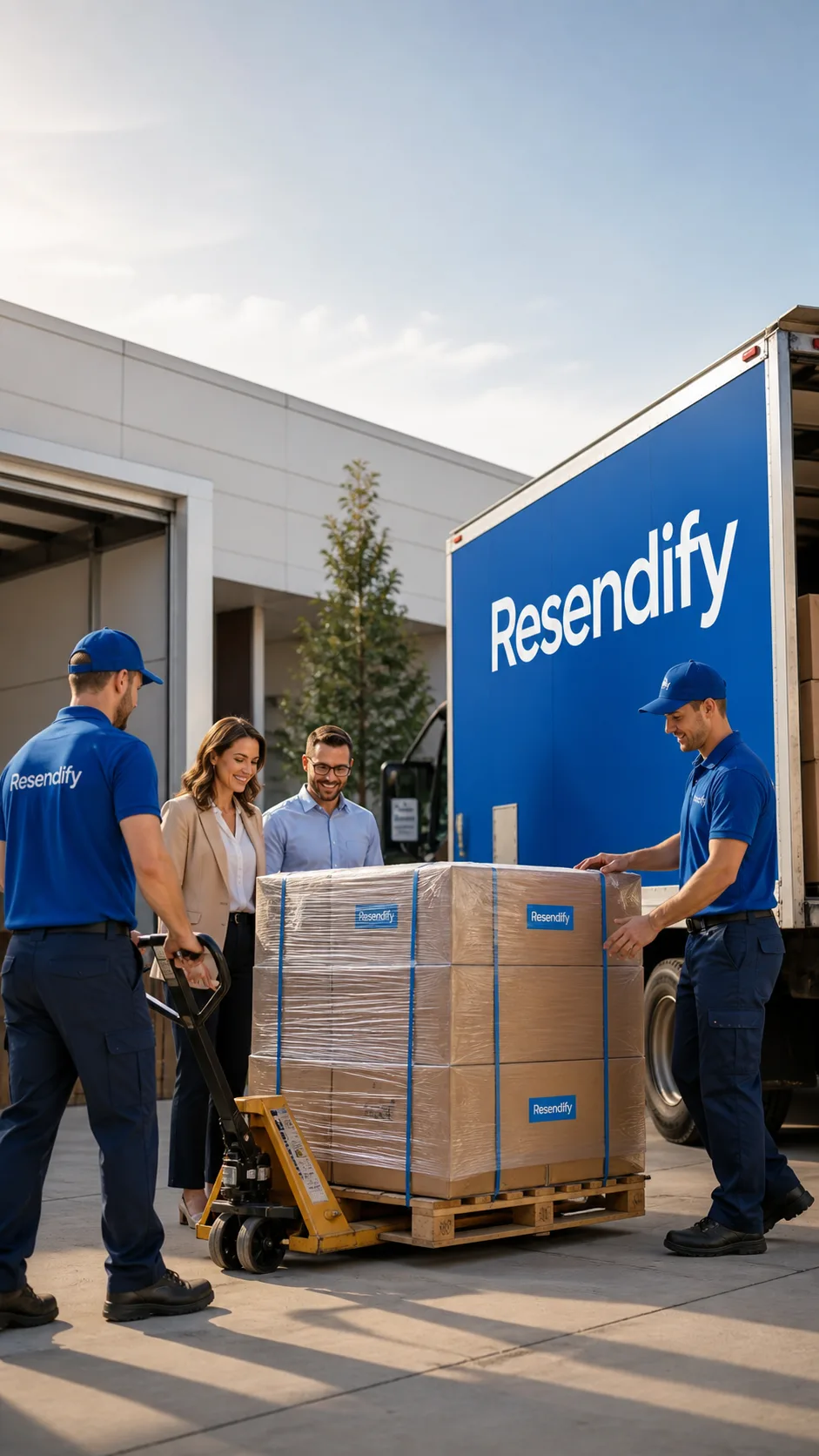
From there it is ours, and it is physical. Everything is received and checked against your order, photographed, weighed and measured. Fragile faces get edge protection and corner boards; heavy items go to the base and the weight is distributed so the load travels square; the stack is strapped and wrapped, and wood packaging is ISPM-15 treated. Then the paperwork happens once for the whole pallet instead of once per parcel: one commercial invoice matching the contents, one packing list, real weights and dimensions.
- A local address in the origin country, so the supplier ships domestically.
- Consolidation across as many suppliers as the order needs.
- Professional palletizing: edge protection, weight distribution, strapping, ISPM-15 wood.
- One commercial invoice and one packing list for the whole shipment.
- Air consolidation, quoted per shipment on the Business plan.
What a pallet out of Italy is usually carrying
These are the orders this lane is built for. None of them is a container and none is a single parcel — they are the awkward middle, where the supplier sells brilliantly at home and stops at the border.
**The lift installer.** Landing doors, car doors, operators, guides and drive units, bought from the district that supplies much of the world's lift industry. The maker delivers anywhere in Italy and nowhere else; the installer is in Bogotá or Monterrey with a building waiting on a certificate.
**The workshop restocking parts.** Braking, performance and interior components, plus the classic-car parts that only exist in Italy — often from sellers that will not ship abroad at all. One order becomes a dozen sellers, and a dozen sellers becomes one pallet.
**The contractor finishing a floor.** Sassuolo porcelain or Carrara stone, ordered in the quantity a project needs rather than the container the factory prefers to load — and needed as one batch, because tone varies between production runs.
**The café or restaurant opening.** An espresso setup from one maker, a deck oven from another, prep and warewashing from a third, arriving over several weeks and leaving as one shipment timed to the opening date.
**The plant with a line down.** A gearbox, a servo, a bearing set. Small, dense, expensive and urgent — the one case where paying for air is obviously right, and where we ship without waiting to consolidate.
If yours looks like one of these, the fastest thing you can do is send us the list: what you are buying, roughly what it weighs and where it has to land. You get a quote against the real load, not a rate card.
- Elevator doors, operators, guides and drive units — a lane we run from Italy and from Spain.
- Vehicle parts: braking, motorsport, interior, and classic components from sellers that stay domestic.
- Stone and porcelain in project quantity, kept in one batch so the tone matches.
- Full opening lists for cafés and restaurants, consolidated to your date.
- Urgent machinery spares, shipped without waiting for the rest of the order.
Importing into Colombia as a company: the courier threshold, ordinary import and EU origin
The threshold story in Colombia has been unstable: Decree 1474 of 2025 changed it, Ruling C-079 of 2026 struck that down, and the effective figure returned to US$200 FOB. Under the courier modality, shipments above that pay 19% VAT plus the single courier tariff, typically around 10%; below it, they are excluded from VAT and pay the courier tariff.
Useful to know — but largely beside the point for you, because that modality is designed for occasional non-commercial shipments, not for a company buying inventory for resale.
What applies to your stock is ordinary import: an import declaration filed against your NIT, normally through a customs agency, with duty by tariff heading plus 19% VAT. Two things then matter. First, if you are an ordinary-regime VAT taxpayer, import VAT is generally creditable against the VAT you charge on sales, which turns it from cost into cash flow — the position is different for simplified-regime taxpayers.
Second, the EU–Colombia trade agreement means goods of genuine EU origin can qualify for preferential duty when your supplier issues the origin declaration, and textiles are exactly the category where the base rates hurt most, so the declaration is worth chasing.
- Courier threshold back to US$200 FOB after Ruling C-079 of 2026 struck down Decree 1474 of 2025
- Courier modality above the threshold: 19% VAT plus the single courier tariff (typically ~10%)
- The courier modality is for occasional non-commercial shipments — stock for resale goes as ordinary import
- Ordinary import: declaration against your NIT, normally via a customs agency, duty by tariff heading plus 19% VAT
- Ordinary-regime VAT taxpayers generally credit import VAT; EU-origin goods may qualify for preferential duty
| Route | Who it is for | Broad treatment |
|---|---|---|
| Courier modality | Occasional, non-commercial | US$200 FOB threshold; above it 19% VAT + ~10% courier tariff |
| Ordinary import | Companies buying stock for resale | Duty by heading + 19% VAT, filed against your NIT |
| EU-origin goods | Either route | Preferential duty possible with origin declaration |
Last updated: Reviewed August 2026. Compiled from Colombian regulatory and trade sources and reviewed August 2026; the low-value regime changed twice between 2025 and 2026, so treat these figures as a planning baseline rather than a ruling. Confirm current rules with the DIAN and your customs agency before committing to an order. Source: DIAN — Dirección de Impuestos y Aduanas Nacionales.
What we publish, and what we will not pretend
Three operations are published on this site with their real figures. An HPL pallet: 150 panels, 296 kg, one pallet, the logistics bill in full, 17 days documented door to door. A gym fit-out: 24 packages, 317 kg, consolidated into a single pallet. And an elevator shipment: two door leaves at 78 kg each plus a 124 kg motor, 280 kg. The first two ran Spain → Mexico; the third, Spain → Colombia.
None of them ran out of Italy. We show them because the operation is identical whatever is on the pallet and wherever it lands — receive from several suppliers, check against the order, build and document one shipment, fly it, hand a clean entry to the importer's broker. What we will not do is attach those numbers to a lane they did not run on.
Your shipment gets quoted on your weight, your volume, your route and your pickup. Transit is an orientative band anchored on those cases, never a delivery promise.
What Resendify does for a business, and what it does not
Being precise about the boundary is more useful than a list of promises. We operate receiving warehouses across ten countries — Spain, Italy, France, Germany, the United Kingdom, Türkiye, the Czech Republic, the United States, China and Hong Kong — so your suppliers deliver domestically, which is what most of them are set up to do.
We check goods in, store them while an order builds across several suppliers, repack when the original packaging is not built for an international leg, consolidate into one shipment, and produce the export documentation: commercial invoice, packing list, real weights and dimensions, and the supplier origin documents that decide whether you pay a preferential duty rate or a full one.
What we are not is your customs broker in the destination country, a distributor, or a party to your trade terms. We do not clear goods on your behalf at destination, we do not hold stock we sell you, and we do not negotiate or guarantee terms with brands.
We also do not quote transit times we cannot control, and we do not tell you your goods will clear without charges. The Business plan exists precisely because a recurring importer needs a quote-based setup rather than a consumer membership: tailored workflows for repeat imports, room for packaging and repacking, volume-oriented planning and commercial support on request.
- Receiving warehouses in 10 countries so suppliers deliver domestically
- Check-in, storage while an order builds, and repacking for the international leg
- Consolidation into one shipment with commercial invoice, packing list, weights and dimensions
- We chase supplier origin declarations — the document that decides preferential duty
- We are not your destination customs broker, not a distributor, and not a party to your trade terms
- Business plan is quote-based: tailored workflows for repeat imports, volume-oriented planning
Pallets from Italy to Colombia: what buyers ask
A single pallet is the format, not a minimum we tolerate. You can start with one order; recurring or larger programmes move to the Business plan, which is quote-based precisely because pallet operations differ too much for a fixed membership.
We will not print a delivery promise, because pickup, consolidation and customs clearance are real variables. The anchors we can show are the published cases: the HPL pallet documented 17 days door to door and the gym fit-out ran approximately Day 0 to around Day 15. Read that as an orientative band on the order of 1–3 weeks for air shipments — orientative, not a promise, and from the lanes those cases actually ran.
We receive in ten countries, so a mixed order is normal. What we will not do is pretend it is free: moving goods between our warehouses to build one pallet is a real cost and gets quoted as a visible line. Sometimes two pallets from two origins beat one consolidated pallet, and we will say so.
Air freight is charged on chargeable weight: the higher of the real weight and the volumetric weight, which in air cargo is usually length × width × height in cm divided by 6,000 (about 167 kg per cubic metre). A light but bulky pallet pays for its volume. Pickup, consolidation, palletizing, export paperwork and the route itself come on top. We don't publish a rate card because it moves with route and date: enter real weights and measures in the quoter and a person prices that exact load.
A parcel-forwarding address — what Latin America calls a casillero — receives personal purchases and forwards them by courier as parcels: built for individuals and occasional orders. Consolidated cargo gathers orders from one or several suppliers into a single commercial shipment, with an invoice, a packing list and a formal import at destination. Resendify does both, but they are different services: if you buy for resale or for a project, consolidated cargo is the one for you.
We are a forwarder and consolidator with warehouses in ten countries: we receive your suppliers' goods, consolidate and palletize them, prepare the commercial invoice and packing list, and quote the air freight to your country. What we don't do is customs clearance at destination: that entry is filed by your local customs broker, who holds the licence there.
Volume and rhythm change what you need. A consumer account is built around occasional parcels; a business buying every month needs storage that fits a build-up across suppliers, packing decisions made per shipment, documentation that a customs agent can file without chasing you, and a quote rather than a fixed membership. That is what the Business plan is for, and it is priced per case because a pallet of tools every month and a monthly box of collectibles are not the same operation.
No. Clearance at destination is done by you or your customs broker, and that is deliberate: local clearance requires local licensing and local liability. What we do is the European side and the paperwork that makes clearance straightforward — a consolidated shipment, a commercial invoice that matches the goods, a packing list, real weights and dimensions and the supplier's origin documents.
Talk to us about the specific supplier before you plan around it. Some situations are simply a delivery address problem, which your European address solves outright. Others involve trade accounts or territorial agreements that are between you and the brand, and no forwarder can resolve those — we would rather tell you which one you are facing than take the order and find out later.
Other pallet lanes
The origin hub: what leaves Italy on a pallet and how the consolidation works.
If part of your order is Spanish, we receive there too — same pallet, same paperwork.
If part of your order is US, we receive there too — same pallet, same paperwork.
one origin serving the whole region, when the destination is not decided yet or the same supplier ships to several countries
a smaller market than its neighbours but an unusually open one, and a frequent first destination for companies testing European sourcing
the largest economy on the continent, and the destination that already sends this site its second-biggest bloc of signups
Many suppliers in, one documented shipment out — one freight and one customs entry.
Tell us what you import
The more concrete this is, the more useful our reply. We receive in ten countries — Spain, Italy, France, Germany, the UK, Türkiye, the Czech Republic, the United States, China and Hong Kong — and forward anywhere, so tell us where you actually buy and where it actually has to land, even if this page is about a different lane.
Start importing palletized cargo from Italy to Colombia on a schedule that fits your business
Tell us what you buy and how often, and we will come back with a setup and a quote — not a generic membership.